How to Make Free Printable Math Worksheets
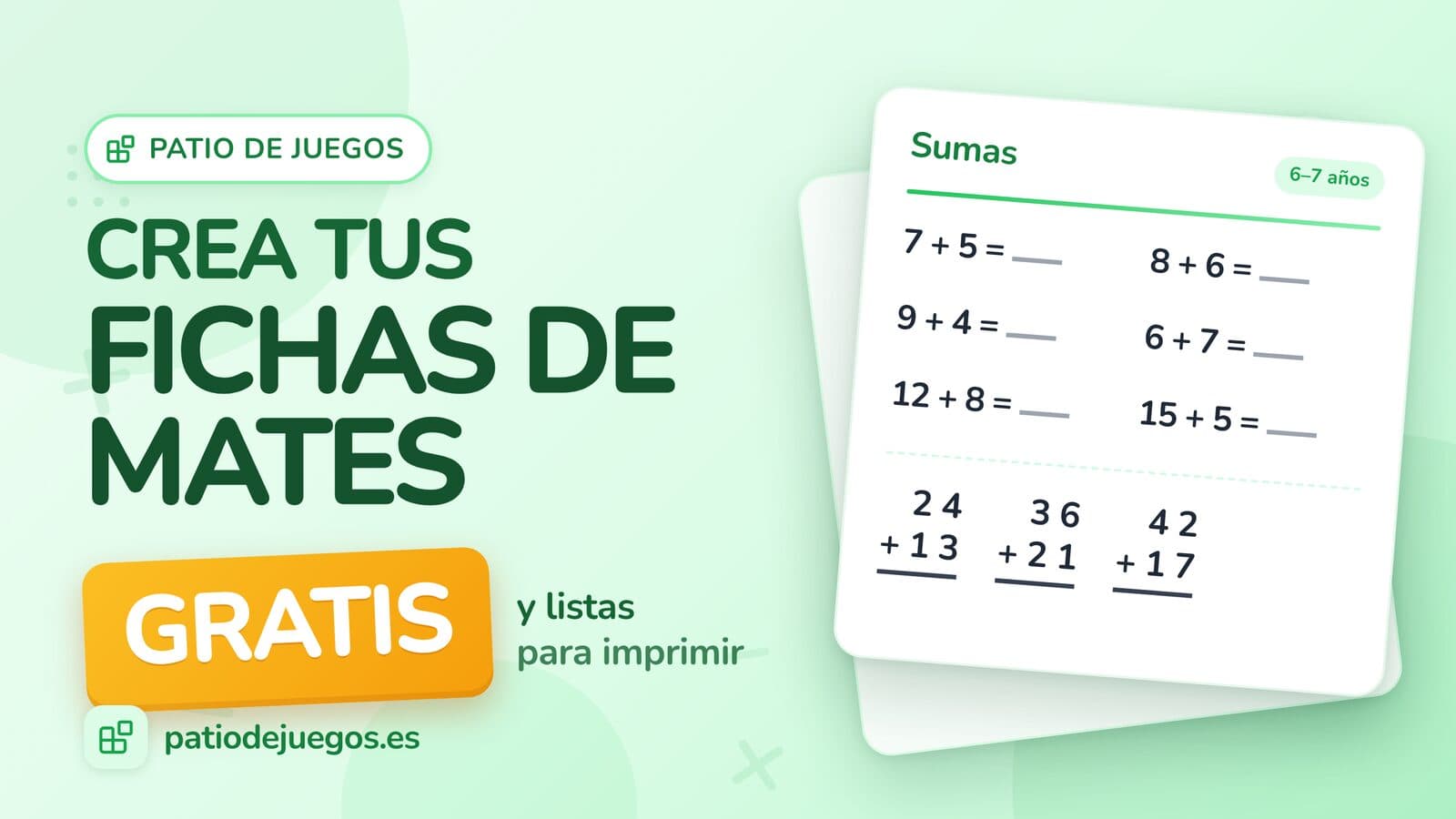
Make Your Own Math Worksheets in About a Minute
Making a math worksheet to print takes under a minute: open the generator, pick the operation, set how high the numbers should go and download the PDF. No sign-up, no watermark, nothing to pay.
The part that decides whether that sheet is worth printing happens before you press the button. Thirty sums up to 100 in front of a five-year-old end up under the sofa, and ten sums from 1 to 5 for an eight-year-old get finished without looking up. Getting the number range and the quantity right is most of the job.
If you would rather watch it, here is the video: how to make free printable math worksheets (in Spanish).
How do you make a math worksheet to print?
Four decisions, none of them longer than a few seconds.
- The operation. Addition, subtraction, multiplication, division, missing number, number patterns, number bonds or putting numbers in order.
- The number range. How high the digits go. This changes the difficulty far more than the operation itself.
- Regrouping or no regrouping. On addition and subtraction you can leave carrying out entirely until your child has met it at school.
- How many problems fit. Fewer than you want to put on there.
Then you generate, check the preview and download the PDF. It comes out in black and white, with room to write under each problem, and prints on A4 or letter without touching your printer settings.
What number range suits which age?
A reasonable starting point, which you then adjust based on what you see:
- Ages 4 and 5. Counting to 10 and sums that total no more than 5 or 6. On fingers, with dried beans, with whatever is on the table.
- Ages 6 and 7. Addition and subtraction to 20 at first, then to 99, without carrying. Carrying in addition turns up towards the end of the year, and borrowing in subtraction a year later. Put a sheet with carrying in front of a child still doing sums without it and you have handed them next year's work.
- Ages 7 and 8. Borrowing in subtraction, which is where most children get stuck, and the first tables: twos, fives and tens.
- Age 9 and up. Multiplication and division by one digit, then by two.
When in doubt, go lower. A child who finishes the whole sheet asks for another one. A child who stalls halfway pushes it away, and next time you produce a worksheet they remember how the last one went.
How many problems should a worksheet have?
Five to ten for the youngest. Up to twenty from about eight, and only if that operation is already comfortable.
The temptation is to fill the page to the bottom because it feels like better use of the paper. What happens instead is that the last rows get rushed to get it over with, and rushing is exactly how mistakes get practised. Eight problems done properly beat thirty done halfway. We wrote a separate guide on that: how to actually use math worksheets with young kids.
Eight kinds of worksheet, not just addition and subtraction
Most people arrive looking for addition, which is a fine place to start, but there is more:
- Addition worksheets and subtraction worksheets, with or without regrouping.
- Multiplication and division, by one digit or two.
- Missing number, the 7 + __ = 12 kind. It forces the operation to be thought through backwards and shows up straight away who memorised and who understood.
- Number patterns: counting by 2s, 5s or 10s and filling the gaps.
- Number bonds, the pairs that make 10, 20 or 100. This is the foundation of mental math.
- Ordering numbers from smallest to largest.
If your child keeps getting stuck on subtraction, check first whether they know their pairs to 10. Two number bond sheets fix more than twenty subtractions in a row.
Every time you generate, the numbers change
Problems are built at random inside the range you chose. You can download five addition sheets up to 20 and all five carry different problems. That covers a whole week of practice on the same skill without handing out the same photocopy five times, and it stops a child memorising where each answer sat on the page.
If your child fails in the same spot every time, generate three or four at that exact range and keep them in a folder. That is the week's practice sorted in two minutes.
Worksheet or game, depending on the moment
When an operation is brand new, paper arrives too early. That stage is what the addition game is for: your child answers on screen, sees immediately whether it was right, and no clock is running. Once it is comfortable, the worksheet consolidates it and leaves a record on paper, which matters more at that age than adults expect. A finished sheet can be shown to someone, stuck on the fridge, looked at.
Something to do today
Think about what your child is working on in class this week. Open the math worksheets, pick that operation, set the range slightly below what they do at school and print a sheet with eight problems. If they finish it and ask for another, raise the range on the next one.
And to see where each option sits before you start, the video walks through it on screen.